

what are porter’s five forces?
It is used to analyze the level of competition within an industry by utilizing industrial organization economics. The purpose is effectively to ascertain the competitive landscape and potential profitability of an industry. Any changes to these forces can directly affect an industry and the companies within it So it is important to understand them and react to them to retain or gain a competitive advantage.
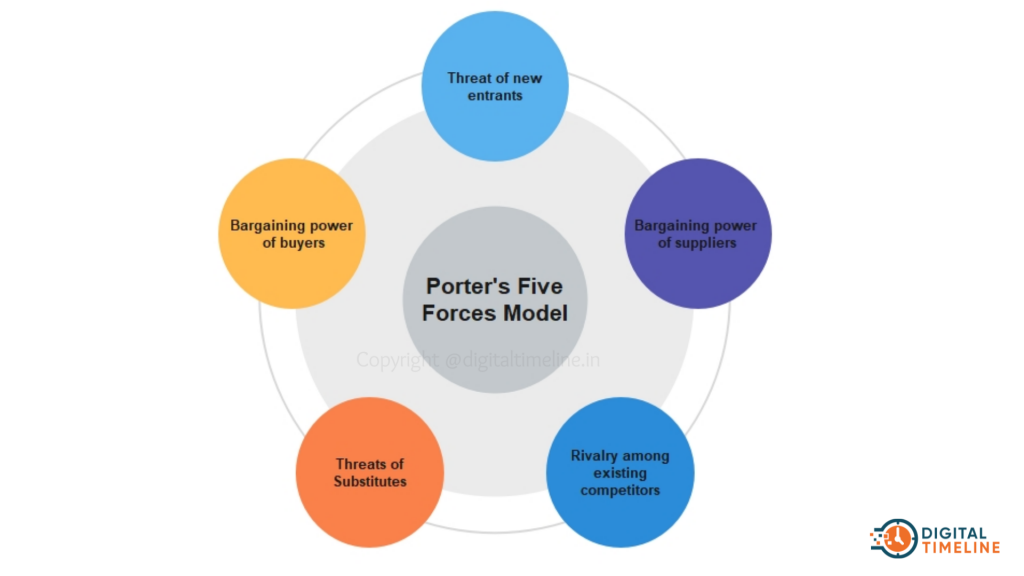
Porter’s five forces are as follows:
• Horizontal competition:
- The Threat Of Substitute Products or Services.
- The Threat Of Established Rivals.
- The Threats Of New Entrants.
- Vertical Competition
4. The Bargaining Power Of Suppliers.
5. The Bargaining Power Of Customers.
The threat of substitute products or services
This first power is the presence of one more comparative item in another industry. A model for the computerized age may be landline telephones versus cell phones or then again, more explicitly, cell phones versus cell phones. Were a new cell phone to be sent off that charges using a case in the home and that has explicit benefits for home use, it might draw in clients who have forever been landline clients thus this is a substitute item danger to landline suppliers.
There are several factors to consider when determining if a product is a substitute threat according to this definition. Those factors are:
- Switching cost: if the switching cost is low then there is a high threat.
- Pricing: if the other product or service is relatively low in price then again the threat is high.
- Product quality: if the potential substitute product or service is of
- superior quality then the threat is high.
- Product performance: if the other product is superior in performance then the threat is again high.
What does this mean for digital marketing?
This threat is ever-present in the digital age as organizations proceed to develop. Tablets have undermined the PC market and phablets have thus undermined the tablet market. 3D images, drones, and numerous others proceed to influence more customary and laid out businesses.

The threat of new entrants
This threat is genuinely self-evident. Another participant in a market can be immediate rivalry and in this way undermine the progress of a laid-out business.
There are many examples of this from the digital age, not least Google, Amazon, eBay, and Twitter. Google entered the search market and quickly became the leader above many established players due to the accuracy and speed of the results. Amazon grew quickly, defeating more established players through excellent customer focus and introducing innovations in personalization that gave them a distinct advantage. Although eBay was not the first auction site it was very simple and easy to use. Finally, Twitter entered the social media space with a new micro-blogging approach that created a very simple
method of sharing new thoughts and insights. It has been relatively easy for online-only businesses to enter many markets in the last 10 to 15 years. Many of the old barriers, especially capital, have been removed.
Some of the factors that can dictate the threat of a new entrant are:
- Barriers to entry: For example patents, and regulations. High entry barriers are attractive to established businesses as they stop new businesses from entering easily. Also, low exit barriers help businesses to leave the industry, which is also attractive. In other words, it is easy for your established competition to leave but difficult for new competition to enter.
- Economies of scale: new entrants are highly likely to be smaller than established businesses and so may not be able to profitably compete on pricing.
● Brand equity: Established Businesses have brand equity – a level of trust that comes with being a recognized brand. Although indeed, new entrants do not have this, it can be quickly established with significant above-the-line marketing spending.
- Industry profitability: If the industry is generally highly profitable then it is likely to attract a large volume of new entrants and vice versa.
- Government policy: There might be government policy in place that limits the ease with which new entrants can join specific industries.
There are numerous different factors like area, anticipated reprisal, innovation, and dissemination and these ought to be generally completely explored and perceived for a methodology to be vigorous.

What does this mean for digital marketing?
Especially for digital marketing, it is surely a fact that new participants are normal to most business sectors and disturbance is ordinary in the 21st hundred years. Factors like area, economies of scale, brand value, and innovation are undeniably less significant for entering numerous enterprises now, for instance, innovation organizations. Innovation organizations have developed at a pace as of late and have drawn in a lot of ventures as organizations hope to disturb the existing ventures.
In 2014 for example, funds worth US$1.4 billion were launched by London-based venture capital firms in just six months (London and Partners, 2014). A large number of organizations are invested in offering digital solutions such as marketing automation, analytics, and social media. This brings results in the digital marketing industry being in an ongoing condition of motion – and assuring you keep pace with these changes is important.
The intensity of competitive rivalry
Competitive rivalry is one of the more normally perceived serious factors and is now and again thought to be the riskiest. The particular highlights and ways of behaving toward your opposition straightforwardly influence your capacity to
attain a competitive advantage.
Alongside digital transformation, there are many other factors, including:
- The competitors themselves: The number of competitors and their relative strength are key factors. If your industry has no industry leaders the playing field is fairly level and so competitor rivalry is increased.
- High exit barriers: If it is difficult to bring out then more businesses will stay in, even if they are only breaking even or even losing money. Competition, therefore, remains high.
- Slow industry growth: if an industry is growing fast then all players can grow through acquisition without necessarily directly affecting the competition. All those new customers can be shared out. If growth is slow then there are no more customers but just as many companies, so to grow you need to acquire customers from your rivals.
In markets where competitive rivalry is high, we move towards ‘incredible rivalry’ or at the end of the day a possibility where everybody competes at an even level with no ‘cost creators’, just ‘cost takers’. Cost creators have the power to impact the cost they charge, though cost takers meaningfully affect the market. I would suggest studying Porter’s five forces and generally around the economic theory to understand this in greater detail.

What does this mean for digital marketing?
There are many factors to think about here and the new pattern toward modernization as advanced change is one of these Moving your business into the computerized age can be an idle and costly process for laid out organizations. This can surely make a change in the competitive geography as younger businesses are more elegant. On the other hand, it is similarly a fact that the bigger organizations, which obviously will more often than not be the more established (although not necessarily), might invest money and resource to make something at scale with advanced innovation that might be less accessible to less settled organizations. Digital transformation can gain your competitive advantage and therefore reduce rivalry.
Bargaining power of suppliers
Suppliers of products or services to companies are another factor in the competitive nature of an industry. The bargaining power of providers straightforwardly influences the capacity for organizations to create again and thusly claim. Strong suppliers have some control over overvaluing and item quality, which reduces an organization’s capacity to create a boost. Weak suppliers on the other hand can be controlled or influenced more by the buyer so the buyer can hold a competitive advantage.

Some of the factors that can lead to high bargaining power for suppliers and therefore increased competition are:
- Few suppliers: If there are fewer suppliers than buyers then suppliers retain more bargaining opportunities.
- Buyer switching costs: If the changing supplier is expensive then the advantage again lies with the buyer.
- Forward integration: If the supplier can produce the product or service themselves then again they are in a position of strength.
What does this mean for digital marketing?
If you are running an e-commerce operation with physical products then you might be working with a distributor for the stock of your commodities. Your provider might be a very rare example or the main provider of the products that you are retailing to your clients. In this present circumstance, the distributer has solid bargaining power as you have restricted choices. This can drive an expansion in costs and in this way your overall revenue. This may accordingly lead to a need to increment costs, which might bring about a decrease in deals. Should a bigger number of wholesalers enter the market than the opposition for your distributer increments, which passes a portion of the dealing power back to you? Another choice is to take a look at creating at any rate a portion of the items yourself to eliminate further power from the distributor.
Bargaining power of buyers
The bargaining power of purchasers is the last and is the capacity of customers to come down on organizations to bring down costs, change their items or further develop client contribution. Businesses can take several
actions to reduce buyer power: for example, engagement strategies and loyalty programs.
Some of the factors that influence buyer bargaining power are:
- Buyer concentration: If there are few consumers and many companies then the buyer effectively has their choice of company.
- Switching costs: As with most of the other forces, switching costs area factor. If it is easy for a buyer to switch then they retain the bargaining power.
- Backward integration: If buyers can produce the products themselves then they again retain the power.

What does this mean for digital marketing?
Probably the best examples of how purchaser dealing power has changed in the digital age are the expanded use of social media and review sites to openly rate and discuss products, pricing, and customer service provided by businesses. Many consumers will include reviews within their decision-making process and will not buy products that match their requirements if the reviews from their equivalents are negative. This has even extended to search engines with star ratings openly displayed within results for searches such as restaurants and products, which can increase or decrease click-through rates as a result. The power of the buyer has significantly increased since Web 2.0.
Wow… amazing.. Nyccc… Its so helpful..
Excellent info
Helpful Content
Amazing
Amazing information thank you for sharing
Nice content thank you for sharing an informative blog post I didn’t know about this before
amazing content
Great content thank you for sharing
Amazing blog!! I found it so useful and worthy!! Keep posting these types of informative blogs!!
Great content sir
really helpful!!
Love this post thank you for sharing
Sucha informative post 😍
very nicely explained
Nicely explained thanks for sharing
Better 👍and super
Very well explained
Love this content